
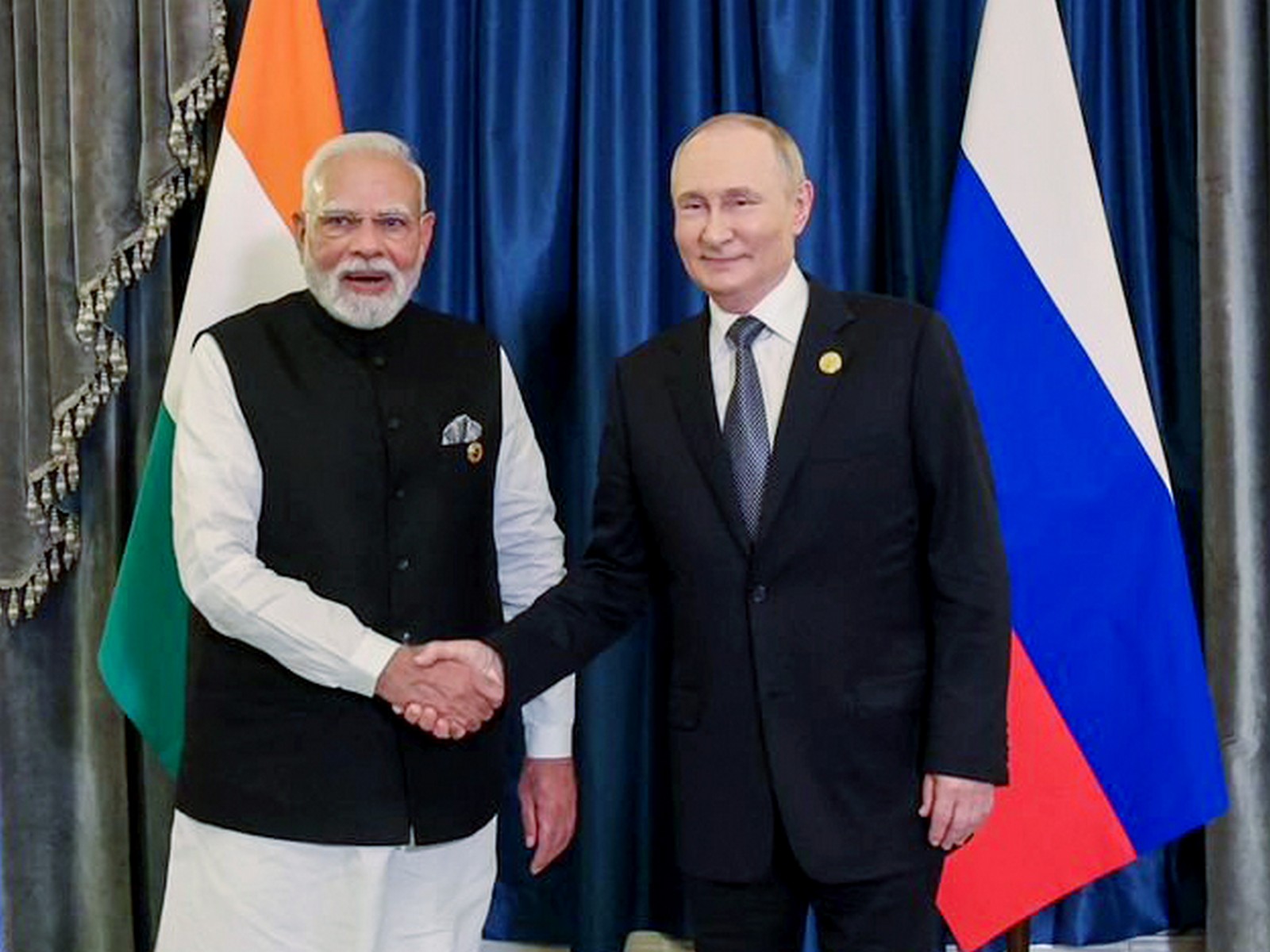
New Delhi [India], December 3 (ANI): Russian President Vladimir Putin’s upcoming visit to India is set to be shaped by risk, supply chains and economic security rather than any return to Cold War-style diplomacy, according to a report by the Global Trade Research Initiative (GTRI).
The report said the visit is ultimately about managing dependence in a fractured world, with outcomes ranging from a modest upgrade in ties to an ambitious reshaping of regional economics.
The GTRI report noted, “Putin’s visit is not a nostalgic return to Cold War diplomacy. It is a negotiation over risk, supply chains and economic insulation. A modest outcome will secure oil and defence; an ambitious one will reshape regional economics. The visit is ultimately not about choosing sides–but about managing dependence in a fractured world.”
According to the report, the likely outcomes of Putin’s visit fall under two scenarios.
In the scenario One, the most probable outcome is a cautious strengthening of current engagements. India may secure firm timelines on defence deliveries, maintenance contracts, and technology upgrades for key military platforms, including aircraft, tanks and submarines.
In return, Russia could push for long-term energy commitments from India, including renewed Indian equity in LNG fields, multi-year crude supply arrangements, and faster progress on nuclear plant construction.
The two nations may also formalize a new payment mechanism using the UAE dirham or link Russia’s SPFS system with India’s RuPay network. This scenario, the GTRI report said, would help stabilize the partnership without creating major diplomatic repercussions.
In the second scenario, a more ambitious scenario would mark a larger strategic shift. This could involve joint production of defence equipment, Indian investment in large Russian oil and gas projects such as Arctic LNG 2 or Vostok, and expanding nuclear cooperation beyond existing reactor projects. Connectivity corridors like Chennai-Vladivostok or sections of the International North-South Transport Corridor could also see acceleration.
A structured settlement system may be introduced to reduce idle rupee balances. While such moves would advance India’s Eurasian integration, the report cautioned that they could also invite stronger reactions from Western countries.
The report highlighted that India exports barely USD 5 billion to Russia annually, compared with imports of nearly USD 64 billion, largely driven by energy. While pharmaceuticals and machinery perform well, India’s presence in garments, electronics and consumer goods remains very limited.
India’s exports rose from USD 4.3 billion in FY24 to USD 4.9 billion in FY25, with USD 2.25 billion exported between April and September 2025. However, imports remain dominated by energy.
Russia has emerged as India’s largest crude supplier, making up nearly one-third of total oil imports in 2024. India’s oil bill for Russian crude surged from USD 2.3 billion in 2021 to USD 52.7 billion in 2024, marking one of the fastest shifts in global energy sourcing.
Payments between the two sides are increasingly de-dollarised, using dirhams, rupees and yuan. This reflects the growing workaround economy created by Western sanctions on Russia.
Beyond symbolic optics, the report shared that the summit is centred on securing fuel, weapons and payments in a world facing financial and political fragmentation.
For India, GTRI highlighted that the key challenge remains maintaining strategic balance, protecting autonomy while managing pressure from Washington and continued dependence on Moscow. (ANI)
Disclaimer: This story is auto-generated from a syndicated feed of ANI; only the image & headline may have been reworked by News Services Division of World News Network Inc Ltd and Palghar News and Pune News and World News

HINDI, MARATHI, GUJARATI, TAMIL, TELUGU, BENGALI, KANNADA, ORIYA, PUNJABI, URDU, MALAYALAM
For more details and packages